Install the App
Add to your home screen for quick access
Putting Down What Was Never Mine
What are you still carrying because you learned early that someone had to? "Putting Down What Was Never Mine", Packet 02 in Empower Recovery's "The Unspoken Work of Recovery", is a 17-page, self-guided workbook for adults who grew up managing other people’s feelings or taking on adult responsibilities. Guided worksheets and practical scripts help you sort what’s yours to carry today, ask for help, and practice setting one manageable limit.
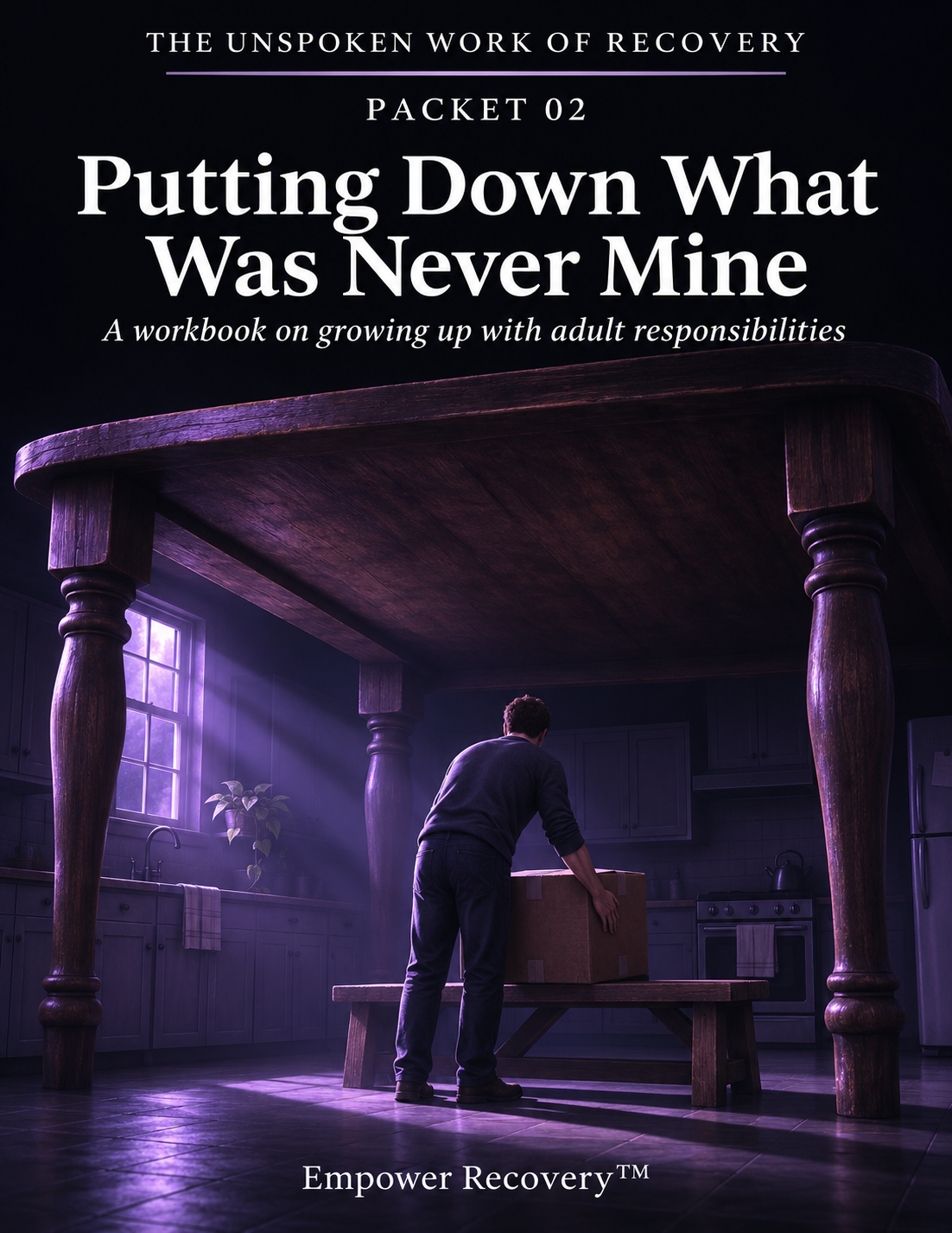
Putting_Down_What_Was_Never_Mine.pdf
Free download — printable self-help packet
**The Child Who Kept the House Together**
What happens when being needed becomes the way you know you belong?
Maybe you listened to the sound of the front door to figure out what kind of evening it would be. You got dinner started, distracted a younger sibling, or sat beside a parent while they told you things you were too young to know how to hold. People called you mature. You may have been proud of what you could do and still wished someone would ask how you were doing.
When a child is regularly expected to carry practical or emotional responsibilities beyond what fits their age, it’s called **parentification**. Years later, that old role can show up in ordinary moments. Two relatives are arguing, and you’ve already drafted a message to both of them. Someone asks if you’re free Saturday, and you say yes before you’ve checked what you need from the weekend. You may still value being the person people can count on. The question is how much choice you have about when you step in and what you offer.
*Putting Down What Was Never Mine* is Packet 02 of *The Unspoken Work of Recovery*, an Empower Recovery™ series. This 17-page, printable workbook uses **3 Awareness · 6 Alignment · 9 Integration** to help you recognize when you automatically take over, sort what’s yours from what can be shared, and try one manageable change in your daily life.
Inside, you’ll find guided worksheets, sample language for setting a limit or asking someone to share a task, and a one-week practice plan. There’s also space to reflect on what comes up when someone is disappointed or when guilt makes you want to take the responsibility back. An optional spiritual reflection and a reusable responsibility check card give you two ways to revisit the work.
This self-paced, nonclinical workbook lets you start with an ordinary situation from your life today. You can keep your answers private and skip any prompt. Start with one responsibility you’ve been carrying and ask yourself: *What part of this did I agree to, and what part did I assume was mine?*
Share this resource